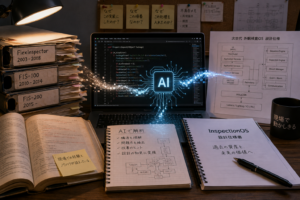
With generative AI, there are fewer and fewer "reasons why it can't be done"
 ovit
ovitThe other day, a member of our staff came to me for advice.
"Our customers are asking for this feature. Users are having trouble with it."
When I listened to what they had to say, this is what they told me.
I want to use AI for visual inspection.
To do that, we need to collect images with defects and use them for training.
But to begin with, defects rarely occur.
That's why I want software that can artificially create defective images.
I see.
I understand exactly what you're saying.
In fact, a common problem with AI for visual inspection is that “defect images are not being collected.”
But if you’d asked me this a little while ago, I probably would have answered like this.
"I get it. But where am I supposed to find the time to make that?"
"I don't really have that much technical know-how, though."
I understand what you want to do.
I can see how it would be handy if you had one.
I understand why the customer is having trouble.
But right now, I have a mountain of tasks to tackle, including developing and debugging existing products, handling customer inquiries, and developing new products.
Just because something looks interesting doesn't mean I can jump right into it.
For now, I had the AI try making it.
Lately, I’ve been using Visual Studio 2026 and GitHub Copilot quite a bit while debugging and improving existing software.
So,
"Well, I guess I'll give it a try."
I decided to give it a try with that kind of mindset.
Let them know what you want to do.
AI writes code.
Let's give it a try.
Let them know what concerns you.
I'll fix it again.
If you keep doing that,
"Hey, this is actually turning out pretty well, isn't it?"
That's how it has turned out.
Of course, you can't expect to get it perfect right from the start.
But it takes shape at a completely different pace than if I were to research, design, and implement everything from scratch all by myself.
"Is there a way to do this a little more efficiently?"
When that happens, people start to get greedy.
"Is there a way to do this a little more efficiently?"
I asked the AI about that.
That's when Codex was introduced.
Try it out,
I give up. I surrender.
That's how it went.
"I want to change this part like this."
"I'd like to add this step."
"I want to change this structure."
"I want to be able to import data like this."
As we continue to make those requests, things gradually take shape.
Of course, we need to think about what we want to create.
You also have to determine whether the result is correct.
But,
"I want to do this" gradually turns into "I did it."
This feeling is quite different from software development as we've known it so far.
It's not about "how many times faster it has become"
When it comes to generative AI,
"Development efficiency has doubled."
"It's 10 times faster."
I often hear people say things like that.
But the impact I feel is a little different.
It's not a matter of how many times.
So far,
I don't have time.
I don't know enough.
Given my priorities, I can't get involved.
So,
"I want to do it, but I don't."
There was something I had concluded was the case.
That was exactly the case with this defective image-generation software as well.
I understand the need for it.
The customer is also having trouble.
If you make it, it'll be useful.
But realistically, I can't bring myself to do it.
That’s where generative AI has made a difference.
"A task that used to take 10 hours now takes just 1 hour."
Or rather,
"I'm now able to tackle work that I couldn't even get started on before."
I think this difference is very significant.
For people who have a mountain of things they want to do, he might be a godsend.
The longer you run a company, the more things you want to do—and the more things you have to do—keep piling up.
I want to improve the software I've been developing for a long time.
I want to build the feature that our customers have been asking for.
I'd like to try out some new technologies, too.
I want to create next-generation products, too.
I'd also like to organize our legacy technical assets.
In my head,
"I'd like to do that someday."
There are tons of them.
But we don't have any more time.
There are limits to the amount of time I can spend learning a new technology from scratch.
So, there are a lot of things I’ve been putting off for a long time.
That's when generative AI came into the picture.
Of course, I’m also grateful when people write code for me.
I'm also grateful that they do research for me.
But what's even more important is,
That it will open, one by one, the doors that had been closed due to limitations of time and knowledge.
That might be the case.
For people who have a mountain of things they want to do and things they have to do,
Generative AI is pretty much a godsend.
No, really.
I give up.