
EXHIBITED AI VISUAL INSPECTION SENSOR FIS-200 AT 2022 INTERNATIONAL ROBOT EXHIBITION
 ovit
ovitWE WILL EXHIBIT AI VISUAL INSPECTION SENSOR FIS-200 AT 2022 INTERNATIONAL ROBOT EXHIBITION TO BE HELD AT TOKYO BIG SIGHT FROM 2022/03/09 TO 2022/03/12.
LTD. IN THE BOOTH OF SANMEI KIKO CO.
7-axis collaborative robot + Keyence LumiTrax + FIS-200 (HALCON deep learning)
Car hood scratch inspection
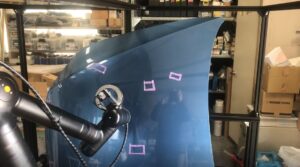
The project was first brought to us in early February by a representative of Sungen Co.
We hurriedly implemented HALCON Deep Learning's "Semantic Segmentation," which was scheduled to be implemented.
This exhibition will be the first time it will be shown.
Our visual inspection sensor is based on the principle of "OK if it is the same as a good product" in terms of simplicity and certainty.
However, even if one side can be set up in 3 minutes, it will take 300 minutes to inspect 100 sides.
It is simply 100 times more difficult to operate.
For this reason, we had previously refused to accept large inspection objects, saying that even if we could make them, they would be very difficult to operate.
However, we knew that if we could define defects and ensure "OK if there are no defects," it would be possible.
This is where "semantic segmentation," one of the deep learning methods, comes in.
As an image, each pixel that makes up an image is classified as "background = OK," "scratch," "dirt," "dust," etc,
Then, a "region (collection of pixels)" is created for each of these categories. If there is only "background," it is "OK.
This year's exhibit will feature
- Set up an imaging route with the robot.
- The robot is moved, the image is captured, and the image is saved in an image file.
- Marking (annotation) of defects in image files. 300 images, about 3 hours.
- Study marked images. Approx. 1 hour.
- Execution.
This is the process that is used to move the product.
Inspection time per surface (2 million pixels) is about 40 ms.
It is considerably faster than the "positioning + comparison" approach, though,
However, the detection capability is "dependent on annotation" and "cannot be determined without trying".
I look forward to seeing how it works in the dusty exhibition hall.