
Visual inspection of resin molded products
Today, we brought a demo machine to a plastic molding company. The shape of the product is cylindrical, and the top, bottom, and sides are to be inspected 360 degrees. The main purpose of the visit was to verify that the side of the product could be inspected stably and to get the customer's satisfaction.
Visual inspection of castings
I have been involved in the visual inspection of a wide variety of products, but there are certain types of products that are difficult to inspect. For example, we have not found the best answer to the question of "dents" or "porosities" on castings. The reason is that the surface of the casting is uneven, and the pattern is not consistent [...].

FROM HALCON 6.0
HALCON, the world's best machine vision system construction tool, was developed by MVTec of Germany and is distributed in Japan by Links, Inc. This HALCON continues to evolve and on November 1 (2016), the latest version "13.0" will be released.
Solution 4] Shomei problem
This is a continuation from the previous post. Here is an image obtained by using a 2.5mm small ring illumination (high angle). The angle of incidence is close to 90 degrees of the coaxial illumination, so the image is relatively close to the coaxial illumination. The smooth areas that have been rubbed have turned white [...].
Solution (3)] Shomei problem
This is a continuation of my previous post. The following is the image obtained when coaxial lighting was used. The smooth area is almost a mirror, so the direct light from the coaxial illumination hits the frayed area and is captured by the camera as it is [...].
Solution 2] Shomei problem
This is a continuation of my previous post. What would the image look like if coaxial illumination was used in #1? Coaxial illumination, also called coaxial epi-illumination, is illumination that shines parallel (90 degrees) to the camera. The lens cap rubs against the [...].
Solution (1)] Shomei problem
This is the answer to my last post. The answer is 3. Large ring illumination (low angle placement). The reason why the rubbed area turns black is because the normal surface of the camera lens cap is a little rough [...].
problem of proof
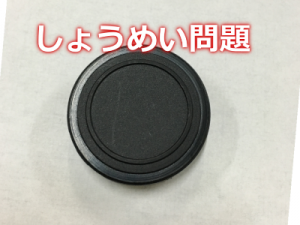
There is a scuff on the camera lens cap. In the image below, the abrasion appears as a vertical black streak. Which of the following three types of illumination was used to capture this image? 1. coaxial illumination 2. small ring illumination (placed at a high angle) 3. large [...].
Concept of inspection speed 5
The actual inspection time required by our FIS-100 software varies depending on the resolution of the camera used, the size of the inspection area, and whether it is OK or NG. Basically, the more pixels to process, the longer it takes. &nbs [...].
Concept of inspection speed 4
IN VISUAL INSPECTION, AN IMAGE WITH A CLEAR CONTRAST (DIFFERENCE IN SHADING/BLACK AND WHITE) IS REQUIRED. WHEN INSPECTING A WORKPIECE THAT IS MOVING AT HIGH SPEED, LED LIGHTING THAT IS ALWAYS ON IS INSUFFICIENT TO PRODUCE A CLEAR CONTRAST IMAGE BECAUSE THE OVERALL IMAGE IS DARK.